The making of · FLATFRONT
Hiding is the game.
Two days from the first idea to fifteen nights on the table. How a man who presses his back to the wall, a dog rebuilt in an afternoon and the real winter of 1943 became FLATFRONT.
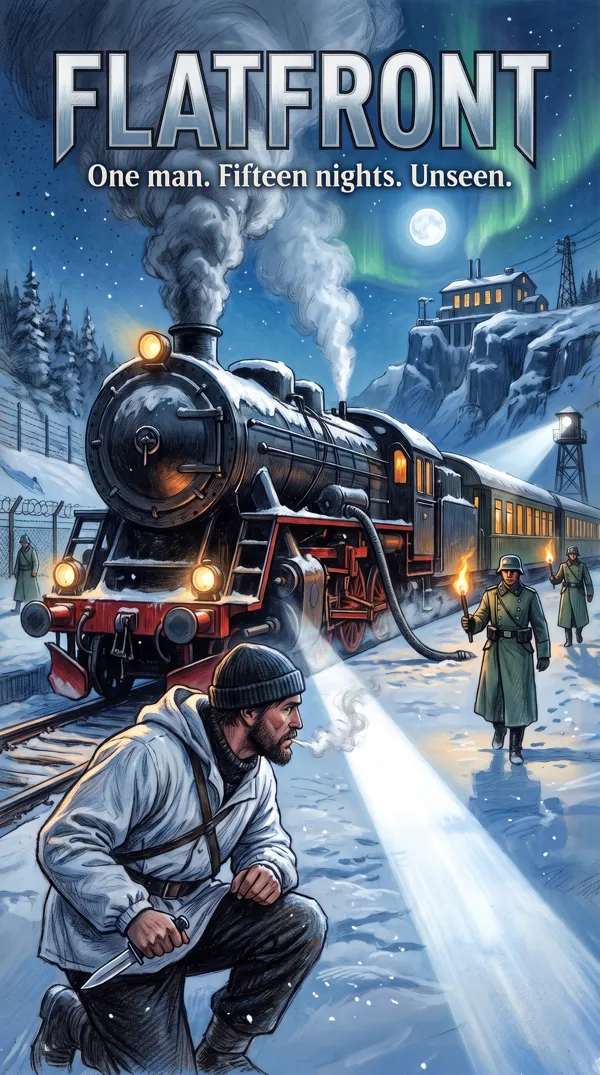
On the morning of 20 October, FLATBOY's newest game didn't exist. Two days later it stood on the table: fifteen nights in occupied Norway, one man in the snow, guards with torches, a dog that follows your footprints. We asked Bjørn Ivar about the details he wouldn't let go of. His answers are the things he said while it was being built, most of them in Norwegian, here in English.
Where did FLATFRONT start?
I want to build a new game, but isometric this time … a sneak-in game. Worlds are large, and you have missions and maps, and you have to sneak, crawl, hide, run. It's a World War Two game, and it's in Norway.
It's only one player.
He had an old game in mind when he wrote that, and dropped it a few minutes later: «It can't be inspired by that. It's way off. It was just a memory I had, about sneaking.» The memory stayed. The reference didn't.
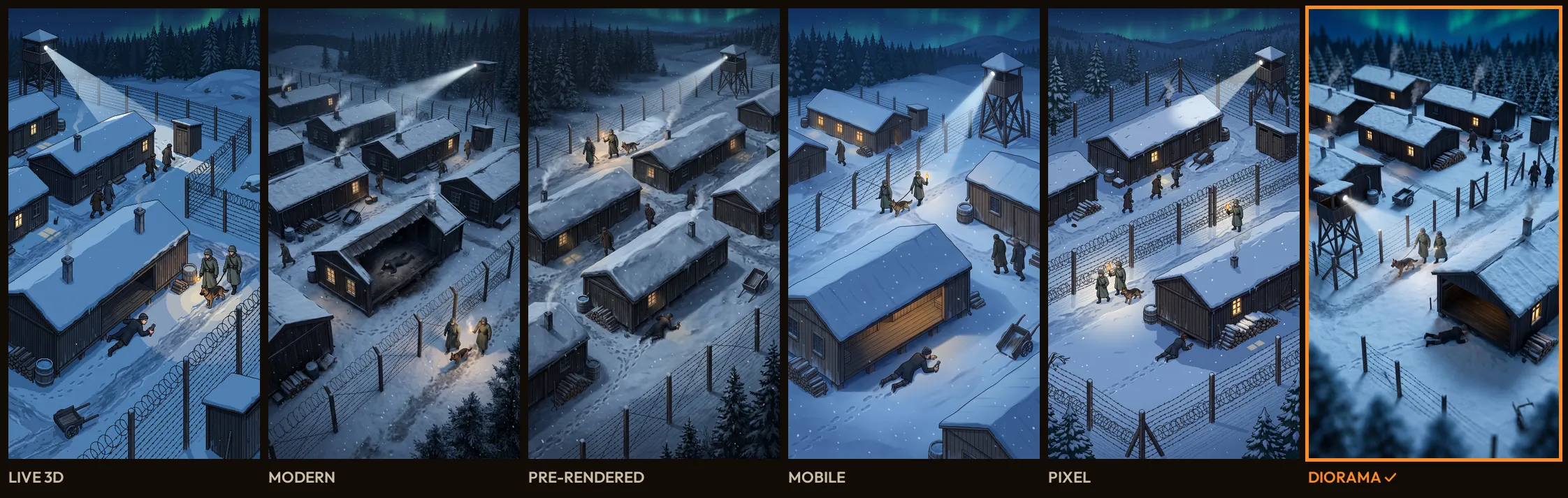
Why does it look like a model on a table?
Diorama was the winner.
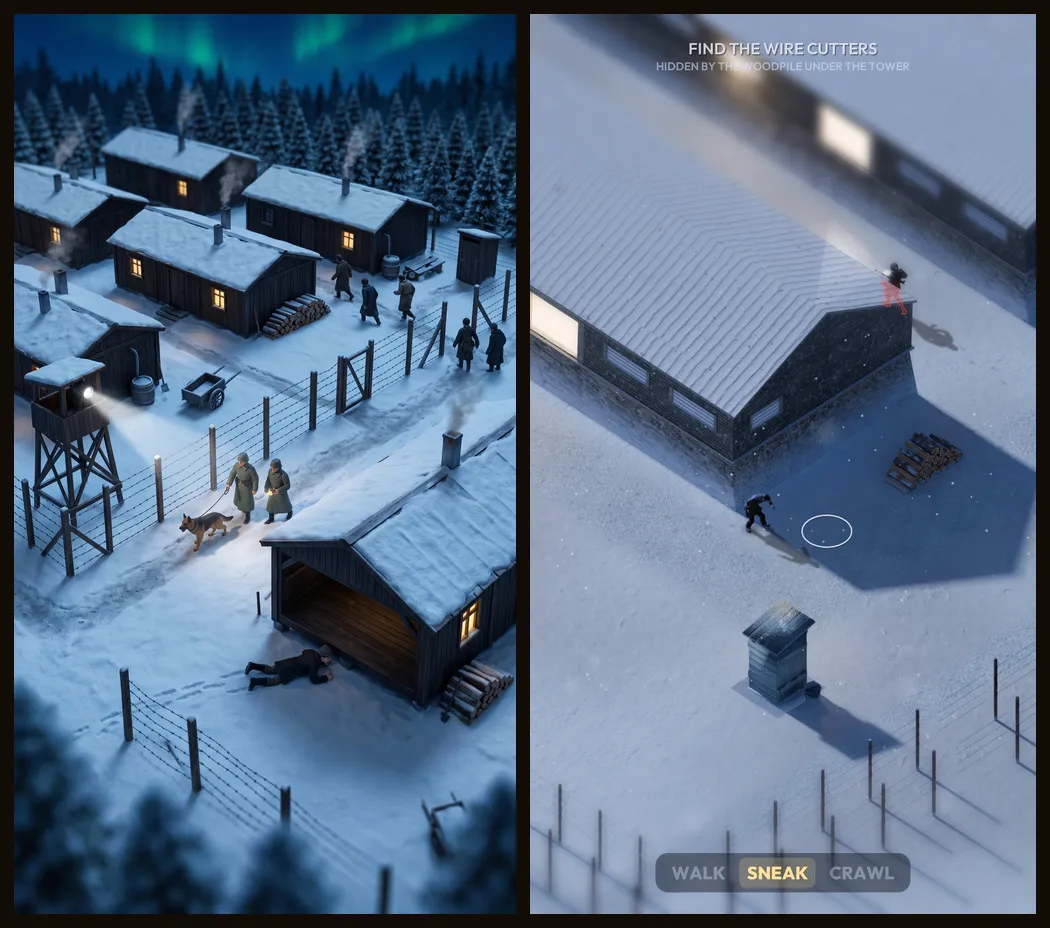
That's the whole answer, and it was enough. The same prison camp was painted six ways: live 3D, modern, pre-rendered, mobile, pixel art and a diorama. The diorama won in four words. So every place in FLATFRONT is built like a real miniature photographed from above: snow that looks like baking soda on balsa barracks, real models of trucks, boats and trains, and a lens that keeps the band where Ravn stands sharp and lets the top and bottom of the picture go soft, the way a macro lens does over a model.
Hiding seems to matter more than anything.
If you press on a wall, a tree, whatever sticks up, he presses himself against it with his back, the way you naturally would when you want to stay hidden.
He has to be right up against it. That's what's natural. And if he's crawling, he has to lie right up against it, lengthwise. … Hiding is an important part of the game.
Hiding is an important part of the game.Bjørn Ivar, the first morning
So Ravn doesn't stop near a wall. He puts his back to it. Crawling, he lies along it. The guards see a sharp cone straight ahead and a wider, shorter one from the corner of the eye; boards block it, barbed wire doesn't. They hear you within the noise of how you move: running is loud, crawling almost silent.
You were strict about how he moves.
We have to get real control of the movements, the transitions. It has to be natural. It can't jump and steer around. Everything has to be natural movement from one state to the next.
Why doesn't the button switch at once? It's impossible to know whether he got the order to sneak, because it doesn't answer straight away. It waits until he has got up or something.
One button now walks you through WALK, SNEAK and CRAWL, and it answers the moment you press it. Something else went the other way the same morning. The ring you move over the snow first snapped onto things, the way it does in another of our games. Within an hour he had seen enough: «It's very hard now. Stop snapping to things, it works badly.» The ring never jumps to anything now. You put it exactly where you mean.
How do you show a man behind a building without spoiling the look?
When he's behind a wall, or enemies are behind something, they have to show as a kind of red figure you see through the building, a bit see-through, so it doesn't spoil the style. Maybe Ravn is blue and the enemies are red.
But not when he's in front of a building. Only behind.
And before you take a step?
An important part of the game is that you can use the stick to scroll around and look at the whole map before you do anything.
I wonder if I want to see fifty per cent more, so the figures get a bit smaller. Then we see more of what's happening.
That's how a night in FLATFRONT starts: you look first. Push the stick far and the view follows, over the wire, the towers and the guards on their rounds. Then you go.
The fifteen nights are full of real history. How did it get in?
Should he blow something up in the end, maybe a factory or something? … Maybe there's a scene where you snipe from a distance, where you suddenly see things through a rifle scope.
Think up an exciting story, inspired by history, by film, by other games. … I want at least twelve to fifteen scenarios like that.
The factory he asked for became Mørkfoss, the heavy-water plant on a shelf over a gorge, and its night is the real one: Vemork, 27 to 28 February 1943, when the saboteurs went down into the gorge, across the river and up the other side, and did it without firing a shot. In the game the night ends on a card that says it: NOT A SHOT FIRED. The last night is the ferry on the lake with the last of the heavy water on board, after the Hydro, sunk on Tinnsjø on 20 February 1944. Ravn goes home to Rjukan.
The rest of the map is the same winter. The prison camp is made up, but drawn from Grini. The fishing boat with refugees in Bergen harbour is the Shetland Bus. The Linge men come down from England, and Sigrid's resistance cell at the sawmill is Milorg. The villa where the commander keeps his prisoners stands for Victoria Terrasse in Oslo, the occupiers' headquarters. The battleship behind her torpedo net in the fjord is the Altafjord's, built on a real model of her sister ship with every flag painted out. The train takes on water at Dombås. The names are changed where the story needed room; the winter isn't. And his idea of the rifle scope is a night of its own.
Stealth is quiet. Where's the excitement?
It has to be doable, and it has to have a bit of juice, even though it's a stealth game.
More things in the scenes, more cool experiences. A few birds flying out of a tree.
The birds are in, and they aren't decoration. Make a noise near a tree and the flock bursts out of the crown, and that is a noise too: the guard nearby comes to look. An owl hoots far off now and then. When a guard almost sees you, the edges of the picture darken red and a heartbeat quickens. Take one down and time slows for a moment and the snow sprays. The guards live their own night: some sleep, sit by a fire or smoke and wake to a sound, patrols turn at the end of their round, and the dog puts its nose to your fresh prints and follows them, its handler behind it.
What didn't work the first time?
The dogs are completely broken.
Seems like the dog's legs move faster than the dog.
It's the lower part of the front legs that is bent the wrong way, it looks like.
Three messages in one afternoon, and the dog was rebuilt from scratch on a real shepherd, paws in step with the ground. The villa had a basement mission until he played it: «It seems completely silly. You walk with your head through the floor. What's the point?» The house was sunk 1.22 metres into the ground and the prisoner moved to a back room. The commander by the boat turned out to have his joints on backwards and was rebuilt. Lamps flickering in the windows were tried and taken out again, because the light had nothing to hang from and became a dot floating in the air. And when the guard's torch found Ravn and the game stuttered, the way the guards find their path was rebuilt until it didn't.
And the sound of a winter night?
The sneaking music is called Frost Watch: strings droning low, a soft heartbeat on a low tom, a cold bell calling now and then with its echo answering from the other side. No hi-hats, no snare, nothing bright on top, so it sits under the wind and the footsteps. The alarm is called Searchlights, and it's tense, not heroic. Get out through the wire and the night's call climbs instead of falling and lands on a held major chord. The footsteps change with how you move, a crunch walking, a careful step sneaking, cloth on snow crawling, all real recordings. The one thing missing from the sound library was the word every war film has, so the guards shout «Hey!».
FLATFRONT is on the table now, fifteen nights long, for one player and whoever sits across from them, leaning in to whisper: crawl. Now.